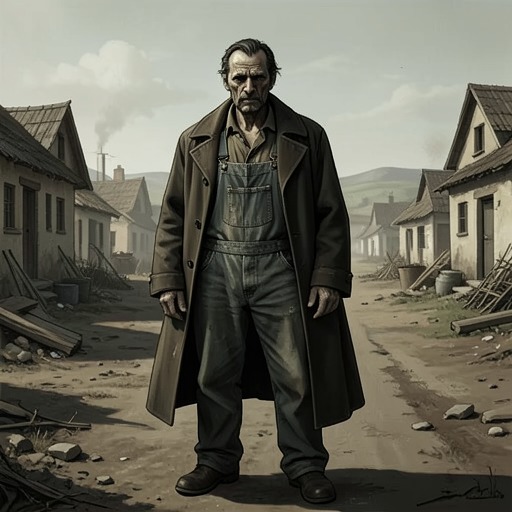
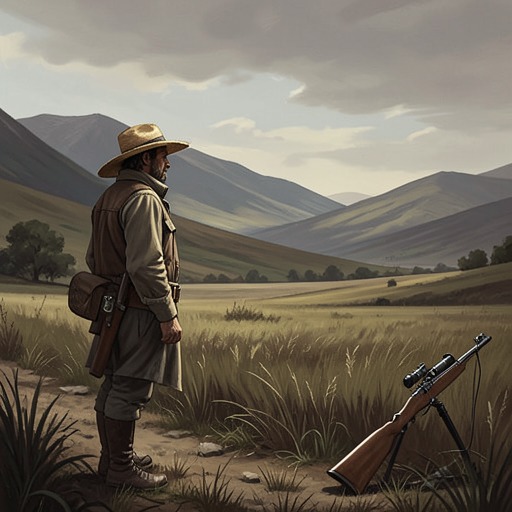
Vovka
Grey BeesVovka, a sniper whose call sign was Vladlen, is known in the novel through the circumstances and aftermath of his death rather than through a developed personal history. A mine placed beneath his position killed him; the crater left behind and the task of gathering what remained make his death a concrete interruption in village life, even as later media coverage tries to control how the war around it is described.
Identity and Death
Pashka identifies Vovka as Vladlen, a man from Omsk whose call sign had become the name by which others knew him. He tells Sergey Sergeyich that Vovka was killed when a mine beneath his position exploded after he lay down there the previous night. The brief account gives the death a precise cause and sequence, but offers little about Vovka beyond his military role and the names attached to him.
The next morning, the position has become a crater at least a metre deep, with earth thrown across the surrounding ground. Men in camouflage distribute black bags and tell those present to fill them. The task turns the death into an improvised process of recovery: the scene is no longer a military position but a damaged patch of ground that must be searched and cleared.
Recovery and Its Aftermath
Sergeyich finds a human ear near the field and puts it into a bag. To make the bag look less empty, he adds lumps of earth. The detail is stark but also procedural: the men are expected to produce bags that can be taken away, and the appearance of fullness becomes part of the work. Pashka and another man return with full bags; Sergeyich’s is only half-full. The driver surveys them and orders that they be loaded into the car.
Vovka’s remains are thus handled collectively, without ceremony or a clear account of what will happen to them afterward. The men’s practical instructions and the indifferent inspection of the bags contrast with the gravity of the death. For Sergeyich, who has come upon the scene while walking with Pashka, the recovery is a direct encounter with what the explosion has left behind; for the group, it is work to be completed and transported.
Vovka’s Death in Public Narratives
Vovka’s death also surfaces indirectly in a later filmed interview with Sergey Sergeyich, who has come from the grey zone with his bees. Asked why he left, he begins to describe the war as a conflict between Ukrainians on one side and Russians on the other. A young man interrupts and tells him to repeat the answer without saying Russians, substituting separatists for the opposing side. The correction makes visible how an account of the war is being narrowed and edited even as it is spoken.
When the interviewer asks why Sergeyich’s car was attacked, he explains that one man struck it after drinking at a wake for a soldier killed by Russians. The young man then stops the live interview and directs the crew to film the bees and the axe mark on a damaged hive instead. Vovka is not explicitly named in this exchange, and the text does not establish that the soldier at the wake was him. The juxtaposition nevertheless places Vovka’s death within a wider pattern of loss and shows how specific accounts of wartime deaths can be displaced by a managed media image.
Narrative Significance
Vovka remains largely absent as an individual, but the narrative gives unusual weight to the practical traces of his death: the mined position, the crater, the bags, and the labor of collecting remains. This shift from a concise report of an explosion to the recovery that follows prevents the death from staying an abstract battlefield fact. Its aftermath occupies ordinary people and ordinary ground.
The later interview scene offers a contrasting kind of aftermath. There, the struggle is over words: who may be named as fighting, and which details are allowed into a public account. The book does not identify Vovka as the soldier at the wake, but his confirmed death and the interview’s redirection together underscore how war is encountered both as material loss and as contested description.